

Reconnecting in a Digital World
Addressing the Loneliness Epidemic Through Real Life Connection
Authors: Brad Steckart, MPA & Deborah Benevenuto, MD
Brad Steckart, MPA is the founder of Sit By Me and a community builder focused on helping people form meaningful, real life relationships in an increasingly digital world. His work centers on designing environments and tools that make human connection easier, more natural, and more present.
Deborah Benevenuto, MD completed her psychiatry residency at the Medical College of Wisconsin and psychiatry fellowship at Yale University. She is a current psychiatrist at Advocate Aurora Health and her clinical work focuses on the evaluation and treatment of acute psychiatric conditions, bringing a frontline medical perspective to how loneliness and disconnection intersect with mental health.
Executive Summary
Loneliness has quietly become one of the most urgent public health challenges of our time. Despite constant connectivity through phones, platforms, and remote tools, many people feel increasingly isolated, less understood, and disconnected from their local communities. Public health institutions now recognize loneliness and social isolation as serious societal risks, linked to worsening mental health, declining productivity, and increased physical illness [1][2].
This paper brings together research, cultural observation, and lived experience to examine how human connection has eroded in a highly digital world and, more importantly, how it can be rebuilt. Rather than positioning technology as the problem, we argue that the real issue is intention. Digital tools have largely been designed to capture attention and optimize engagement, not to move people toward meaningful, real world connection.
We conclude by introducing Sit By Me, a platform designed to help people meet in real life, in real time. When technology is used as a bridge instead of a replacement, it can help individuals, businesses, and communities rebuild authentic connection where it matters most.
Loneliness in a Hyperconnected World
We live in a current paradox. Communication has never been easier, yet loneliness is rising across nearly every age group [3]. Young adults report fewer close friendships, older adults experience increasing social isolation, and many people feel alone even while surrounded by others. This is not the result of personal failure or social apathy. It is the predictable outcome of systems that prioritize efficiency, convenience, and performance over presence and relationship.
Loneliness matters because it affects far more than emotional well-being. Chronic social isolation is associated with higher rates of depression and anxiety, increased risk of cardiovascular disease and stroke, and a shorter life expectancy. Large population studies suggest that the health risks of loneliness rival those of smoking and obesity [4][5]. Over time, these effects compound, weakening families, workplaces, and communities.
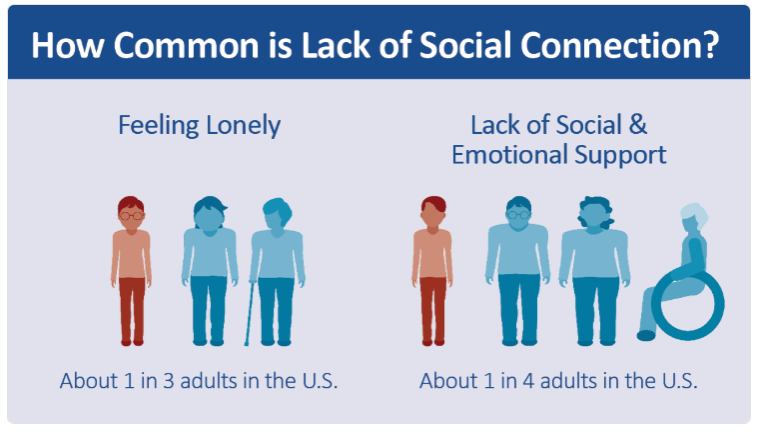
[Figure 1. About 1 in 3 adults in the U.S. report feeling lonely. About 1 in 4 U.S. adults report not having social and emotional support. Centers for Disease Control and Prevention. “Health Effects of Social Isolation and Loneliness.” 2024]
How Technology Drifted from Connection
Digital platforms were initially created to bring people together. Over time, many evolved to reward visibility, productivity, and performance rather than depth or vulnerability. Likes, follows, and engagement metrics create the appearance of connection while often discouraging authenticity. Interaction becomes something to curate and display instead of something to experience.
At the same time, modern convenience has reduced opportunities for spontaneous human interaction. Food delivery, remote work, algorithmic entertainment, and on demand services minimize friction but also minimize moments of unplanned connection. Physical gathering spaces still exist, but they are increasingly underutilized as social environments.
What We Need to Feel Connected
Decades of research point to a consistent truth. Meaningful connection is built through physical proximity, shared experience, and psychological safety. People connect more naturally when they are in the same place, doing something together, and when the social environment feels low pressure and welcoming. Social connection functions as a protective factor for both mental and physical health, while isolation increases vulnerability across the lifespan [1][2].
Face to face interaction remains uniquely powerful. Eye contact, tone of voice, body language, and shared context activate emotional and neurological pathways that digital communication cannot fully replicate. Connection is not simply an exchange of information. It is a lived experience that builds trust, memory, and belonging.
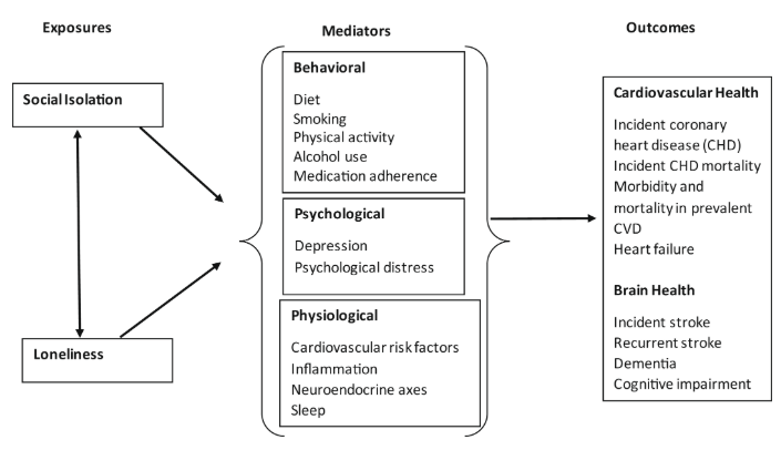
[Figure 2. Conceptual model examining associations between social isolation, loneliness, and outcomes. Adapted from Hodgson et al. Copyright 2020 The Authors. Published on behalf of the Royal Society of Medicine by Sage Publishing. This is an open access article under the terms of the Creative Commons Attribution‐By Author License, which permits use, distribution, and reproduction in any medium, provided the original work is properly cited.]
Using Technology as a Bridge, Not a Barrier
Technology itself is not inherently isolating. When designed with intention, it can lower the barrier to meeting others, reduce social uncertainty, and activate existing physical spaces. The opportunity lies in shifting from platforms that maximize screen time to tools that motivate real world action.
The future of social technology is not more digital interaction. It is more purposeful use of technology that leads people back into shared physical spaces. Success should be measured not by time spent online, but by relationships formed offline.
Sit By Me: Designing for Real Life Connection
Sit By Me is a social engagement platform designed to help people meet ‘in real life, in real time’ at local businesses and community spaces. It reduces the hesitation and uncertainty that often prevent people from starting conversations and creates clear, low-pressure signals for connection. Reducing friction by sending fun ice-breaker questions, connecting through mutual friends, and giving the ability to chat prior to an initial face-to-face interaction.
By anchoring interaction to physical locations and encouraging opt-in participation, Sit By Me allows technology to support each moment of interaction without replacing it with a screen. Individuals expand their social circles, businesses become modern community hubs, and cities strengthen trust and social fabric through everyday interactions.
Evidence at-a-Glance
Approximately one in six adults worldwide report frequent feelings of loneliness, a trend observed across age groups [1]. Chronic loneliness is associated with increased risk of depression, anxiety, heart attack, stroke, and premature mortality, with effects comparable to smoking and obesity [3][4]. Conversely, intentional in person engagement is linked to improved mental health, resilience, and overall well-being. These findings underscore the urgent need for solutions that facilitate real life connection while using technology as a supportive bridge rather than a substitute.
Conclusion: A Call to Reconnect
Loneliness is not inevitable. It is the result of design choices, cultural habits, and systems that can be changed.
Public health data and clinical experience increasingly point to social connection as a foundational determinant of mental and physical health. By prioritizing presence and using technology with intention, communities can rebuild the social fabric that supports belonging and resilience.
The path forward is simple, though not always easy. Build your relationships in real life, in real time.
Sit By Me is an invitation to do exactly that. Learn more at www.sitbyme.co.
References
[1] World Health Organization. “Loneliness and Isolation: The Hidden Threat to Global Health We Can No Longer Ignore.” 2025.
[2] Centers for Disease Control and Prevention. “Health Effects of Social Isolation and Loneliness.” 2024.
[3] World Health Organization. From Loneliness to Social Connection: Charting a Path to Healthier Societies. WHO Commission on Social Connection, 30 June 2025.
[4] Harris, E. “Social Isolation and Loneliness Are Linked to Higher Mortality Risk.” JAMA Network, 2025.
[5] American Heart Association. “Social Isolation and Loneliness Can Damage Heart and Brain Health.” 2022.
Figure 1: Centers for Disease Control and Prevention. “Health Effects of Social Isolation and Loneliness.” 2024
Figure 2: Hodgson S, Watts I, Fraser S, Roderick P, Dambha‐Miller H. Loneliness, social isolation, cardiovascular disease and mortality: a synthesis of the literature and conceptual framework. J R Soc Med. 2020;113:185–192.